
What You Need to Start a Cooking Oil ATM Business

Launching a salad oil dispensing station is one of the most practical ways to break into retail micro-investments. Because cooking oil is a recurring daily necessity for every household, a vending station provides quick, recurring cash returns.
However, translating this concept into a thriving enterprise requires careful preparation. If you want to start a cooking oil ATM business that runs smoothly without unexpected operational costs, you must secure four foundational pillars: a strategic premises, regulatory permits, reliable inventory pipelines, and premium hardware.
1. Securing an Ideal Business Premises
Location is the primary variable that determines your daily sales velocity. When evaluating potential commercial rooms or estate kiosks to rent, map your options against these core operational criteria:
-
Physical Accessibility: The structure must sit directly in the pathway of your target walk-in customers and remain easily reachable for wholesale supply deliveries.
-
Space Allocation: If your sole focus is dispensing cooking oil, a highly compact space measuring just $1.5 \text{ meters} \times 1.5 \text{ meters}$ is completely sufficient. However, if you plan to cross-sell companion fast-moving consumer goods (FMCG) like rice or flour, budget for a larger room.
-
Power Infrastructure: Cooking oil ATMs run on a continuous electrical grid connection. Ensure your premises has stable power or access to a reliable solar array, which is significantly more affordable than running a fuel generator. Save fuel generators strictly for emergency national grid blackouts to protect your profit margins from high fuel overheads.
-
Cost vs. Return Balance: For small startups, working capital is often limited. Avoid costly rentals that drain your daily cash flow. Your monthly revenue must comfortably cover recurring expenses like rent, utilities, and helper wages while leaving a healthy net profit.

2. Compliance and Licensing Requirements
Operating a legal, hassle-free commercial outlet in Kenya requires compliance with both national and county regulatory frameworks.
-
National Entity Registration: Before approaching local authorities, register your business name or private limited company on the national eCitizen platform via the Business Registration Service (BRS). This step is required to generate your enterprise’s Kenya Revenue Authority (KRA) PIN.
-
Unified Business Permit (UBP): Visit your local county licensing office (or log onto portals like NairobiPay or the Kiambu County digital system) to apply for your annual Single Business Permit. Annual costs typically scale based on your location zone and staff size:
| County Jurisdiction | Small Trader Kiosk (1–2 Staff) | Medium Retail Shop | Startup Incentives / Notes |
| Nairobi City County | $\sim\text{KES 4,000}$ | $\text{KES 7,500} – 15,200$ | Look out for active startup fee waivers introduced for new small youth ventures. |
| Kiambu County | $\text{KES 3,500} – 5,000$ | $\text{KES 6,500} – 10,000$ | Uses a zoning system (Zone A: Ruiru, Juja, Thika pays slightly higher rates). |
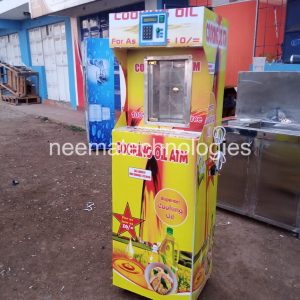
3. Establishing a Reliable Supply Chain
Your wholesale inventory pipeline can make or break consumer loyalty. If your shop frequently runs out of cooking oil, customers will quickly switch to a nearby competitor.
To insulate your enterprise against distribution delays, always maintain a minimum 1-week buffer stock in your backroom. If your retail shop operates in a remote or rural trading center where wholesale delivery trucks visit less frequently, expand your emergency backup reserves to last 2 to 4 weeks.
4. Sourcing a High-Performance Salad ATM Machine
Your central automated machine is the most critical piece of infrastructure you will buy. Investing in low-grade, unverified hardware leads to frequent component failures, inaccurate oil measurement calibration, and internal oil solidification.
[Raw Bulk Drum] ---> [Thermal Heating Element] ---> [PLC Micro-Processor] ---> [Exact Nozzle Dispense]
When selecting your machine configuration, ensure it features an integrated Programmable Logic Controller (PLC). The PLC acts as the brain of the unit, automating your bookkeeping by tracking daily financial sales logs, protecting your pricing settings behind an administrative password, and ensuring customers get the exact amount of oil they pay for.

Buy Certified Cooking Oil ATMs from Neema Technologies
To ensure maximum equipment uptime and reliable retail accuracy, source your equipment from the leading local manufacturer.
Neema Technologies designs and builds high-durability, food-grade salad oil vending machines countrywide from our modern fabrication workshop in Nairobi. Our systems meet the highest local manufacturing quality standards, offering features like internal digital thermal regulators to keep oil liquid during cold mornings, precise PLC budgeting logic, and flexible storage capacities tailored to your budget.
Place Your Machinery Order Today
Ready to start a cooking oil ATM business with equipment built to last? Get in touch with our technical sales consultants for customized configurations, countrywide delivery timelines, and pricing:
-
📍 Showroom Workshop: Ruiru, Kenya (Conveniently accessible along the highway)
-
📞 Mobile / WhatsApp Support: +254 792 880966
-
📧 Official Email Inquiries: info@neematechnologies.co.ke
-
🌐 Digital Catalog: Explore Neema Technologies Commercial ATM Range