
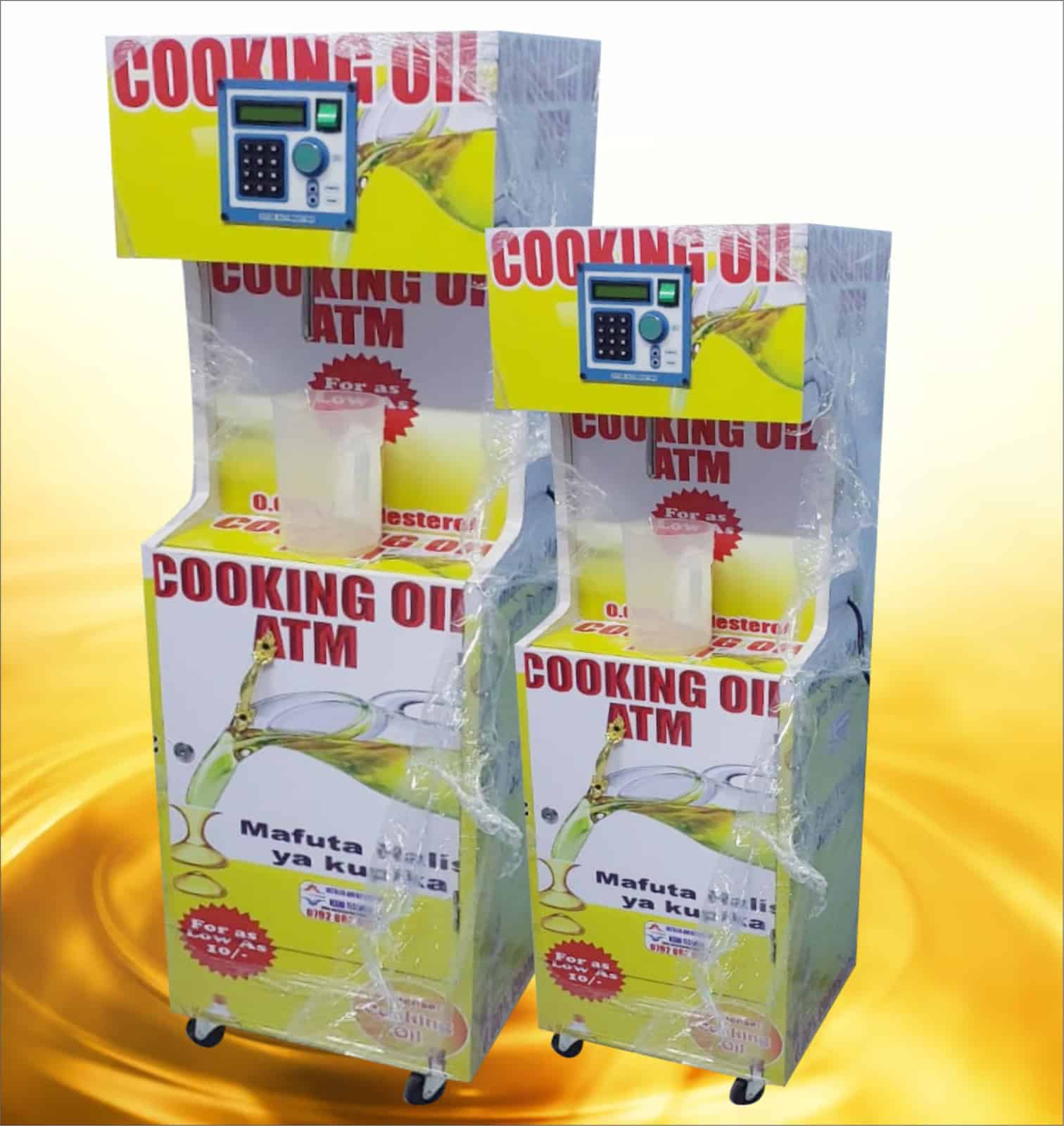
Cooking Oil ATM Specifications: The Complete Technical Guide for Kenyan Entrepreneurs
When investing in the retail sector in Kenya, automated micro-dispensing has proven to be a game-changer. Dispensing cooking oil via a specialized vending machine—popularly known in the Kenyan market as a Cooking Oil ATM or Salad ATM—allows business owners to sell oil based on any customer’s budget, starting as low as KSh 10 or KSh 20.
However, running a long-term, trouble-free vending business requires looking beyond basic aesthetic design. Vegetable and salad oils have distinct physical and chemical properties, such as changes in viscosity during cold mornings, which demand precise engineering. Reviewing detailed Cooking Oil ATM Specifications before making a purchase ensures you invest in a machine built for accuracy, hygiene, and durability.
At Neema Technologies in Ruiru, we manufacture industrial, commercial-grade edible oil dispensers custom-tailored to handle the local climate and specific trading conditions.
Core Technical Specifications Matrix
A reliable dispenser must combine accurate flow measurement with food-safe storage. Our standard factory builds at Neema Technologies feature the following underlying specifications:
| Technical Parameter | Specification Standard | Purpose & Functional Benefit |
| Material Construction | Food-Grade Stainless Steel (Grade 304) | Prevents oil contamination, resists chemical reactions, easy to clean. |
| Control System Logic | Programmable Logic Controller (PLC) | Controls calibration down to the milliliter for accurate sales audits. |
| Viscosity Control | Low-Consumption Submerged Thermal Element | Keeps oil fluid during cold mornings ($15^\circ\text{C}$ or lower) without overheating. |
| Voltage & Power Input | 220V – 240V AC, 50Hz (Standard Single Phase) | Plugs directly into standard Kenyan grid sockets; low idle consumption. |
| Payment Validators | Multi-Coin Validator & Integrated M-Pesa API | Accepts KSh 5, 10, 20 coins; handles direct mobile cashless payments. |
| Dispensing Accuracy | Deviation limit less than $\pm0.5\%$ | Minimizes product loss, ensuring exact portion sizes for every purchase. |
Essential Engineering Components Explained
1. Smart PLC Micro-Accounting Board
The brain of the machine is the Programmable Logic Controller (PLC). This micro-computer counts electrical pulses sent from a high-precision flow sensor as oil passes through the food tubes.
-
Key Advantage: It allows you to update your unit pricing instantly if wholesale market costs shift. For example, if bulk wholesale oil prices change, you can update the system interface to automatically adjust how much oil is dispensed per shilling.
-
Phone Monitoring: The accounting board maintains a non-resettable log of lifetime sales. This allows you to verify physical cash totals against digital logs, preventing unauthorized staff access or inventory shrinkage.
2. Integrated Thermal Heating Elements
Unlike water or milk, edible vegetable oils solidify or become sluggish when ambient temperatures drop, particularly during chilly weather common in areas like Limuru, Nairobi, or Eldoret.
-
Key Advantage: Neema units come standard with an automated, low-wattage heating jacket. It warms the product slightly to maintain optimal fluid consistency, preventing strain on the pump and keeping lines clear without degrading the oil’s nutritional value.
3. Food-Grade Pump and Stainless Piping
Using standard plastic water lines or industrial fuel pumps causes chemical leaching, altering the oil’s flavor profile and violating safety standards.
-
Key Advantage: All intake manifolds, internal storage holding tanks, delivery pumps, and dispensing nozzles are constructed using food-certified Grade 304 Stainless Steel. This structure ensures absolute compliance with public health rules and the Kenya Bureau of Standards (KEBS).
Step-by-Step Business Setup & Siting Process
Launching a profitable retail footprint requires a deliberate mechanical layout and strategic positioning:
Verify the site has access to a stable 240V power source. Measure available counter space to ensure adequate clearance for bulk product refills.
Match your machine size to local market traffic. Choose a 50-liter or 100-liter model for standalone estate shops, or up to 200+ liters for high-volume wholesale supermarkets.
Mount the machine securely on-site. Calibrate flow rates using your preferred wholesale oil brand and map the digital terminal to your business M-Pesa Till Number.
Initiate regular wipe-down routines for the dispensing nozzle and clean external stainless trays daily to maintain a pristine, customer-friendly retail environment.
Strategic Locations for High Daily Volumes
Maximizing daily sales volume depends heavily on choosing an accessible, high-footfall retail location:
-
Estate Kiosks and Residential Hubs: Placing your unit inside high-density residential developments gives local families immediate access to cooking oil refills right outside their doors.
-
General Minimarts and Butcheries: Integrating a compact counter-top machine alongside established grocery cash registers captures natural up-sell opportunities from everyday shoppers.
-
Fresh Water Refill Stations: Co-locating a Cooking Oil ATM beside your automated water dispenser lets you run a “one-stop refill shop,” capturing multiple revenue streams from the same foot traffic.
Expected Capital Payback Trajectory
Because you source wholesale oil in 20-liter or 200-liter barrels at bulk discounts and distribute it via high-margin micro-portions, your profit margin remains remarkably consistent.
Focus on setting local per-milliliter pricing, introducing local shoppers to bottle refilling, and establishing daily sanitation routines.
With a stable location selling 60 to 100 liters of cooking oil daily, most retail entrepreneurs fully recover their initial machinery capital within 6 to 10 months.
Pure profit generation supported by minimal electricity usage, zero single-use plastic waste, and durable stainless hardware components.
Order Your Custom Machinery from Neema Technologies
Automating your retail inventory removes manual errors, tracks cash flow accurately, and lowers your everyday staffing requirements. By pairing robust Cooking Oil ATM Specifications with reliable local spare parts, technical training, and a 1-year comprehensive warranty, Neema Technologies helps you launch a successful, scalable enterprise.
Get in touch with our engineering and sales office in Ruiru today to schedule a demo or get a custom manufacturing quotation:
-
📍 Workshop Address: Ruiru, Kenya (Behind Shell Petrol Station)
-
📞 Call/WhatsApp: +254 792 880966
-
📧 Email: info@neematechnologies.co.ke
-
🌐 Website: neematechnologies.co.ke